AI in Medicine
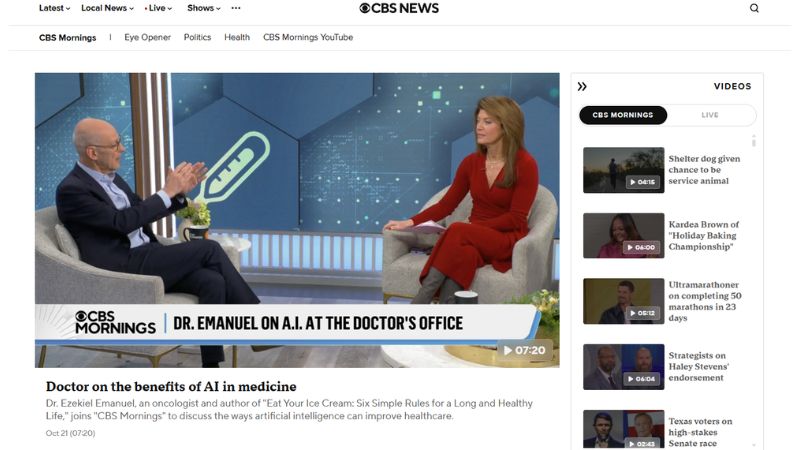
One of Noreta Family Medicine’s patients sent me this video from CBS Mornings, where Dr. Ezekiel Emanuel talks about how AI is going to replace doctors. After watching the video, my opinion is that he was trying to a) generate controversy to sell his book and b) get his brother elected! Despite this, there were some interesting AI topics that were discussed. I wanted to talk about the state of “usual physician use” of AI, right now, in November 2026 as seen by me, a primary care doctor in Columbia, SC 😊
One of Dr. Emanuel’s first statements is that he believes AI will do a better job of managing chronic medical problems in the future, especially ones that are very “algorithmic.” My opinion – no chronic medical problem is completely algorithmic! Sure, the guidelines might recommend a specific first, second or third-line medicine, but what if a patient doesn’t WANT to take one of those medicines (for whatever reason!), or is concerned about certain side effects? Also, what happens when a patient stops taking a blood pressure medicine (for example) due to hearing something negative about it online and their blood pressure starts to rise? Will AI know that they simply need reassurance to start taking their medicine again, and not an additional medicine? By the way, this situation happens all the time in my family medicine office!
I loved the part of the interview where one of the hosts quoted the AMA president’s op-ed where he asked if we can imagine a world in which AI gives you a cancer diagnosis. We joke about the internet telling someone they are going to die from a paper cut, or other benign problem all the time in the office. Can you imagine though if the answer was that you had cancer and it was true? It’s chilling for me to think about a computer giving a life-altering diagnosis to a patient. I’m sure some AI doctor avatar would say this in a gentle way, but where is the hug or the Kleenex? Dr. Emanuel responded that there will still be a place for non-AI medical interactions in the future. My opinion – most of my interactions with patients are emotional now, and I believe that leads to better care.
Regarding the study that showed that AI does a better job of diagnosing patients than humans, I have not gone through the study. However, a few months back, a patient came in and I was initially stumped about what was going on. I put the symptoms into Open Evidence, the AI program mentioned in this video, and it gave me a list of possible diagnoses and initial testing to order. I found it to be helpful at this point. I ordered tests that I thought were relevant (which was not all of what AI suggested!) and as the results came back, I decided to keep using AI. The more results I put into AI, the more it steered me in the WRONG direction. Don’t worry, I wasn’t using it for advice at this point 😊, I was conducting an AI experiment. I came to a firm diagnosis, which was different than the conclusion AI came to.
So…..while the future power of AI in medicine is intriguing, the current power of AI is about the synthesis and organization of data provided to it. AI can “listen” to a conversation between a doctor and patient and turn it into an office visit note. AI can combine breast cancer screening recommendations from different groups that make screening guidelines – American Cancer Society, US Preventive Services Task Force, American College of OB/GYN, etc. However, the version of medical AI that I used in my primary care office is not ready to replace me when it comes to diagnosing patients!
Both as a word of caution and in agreement with the video, PLEASE do not use AI to diagnose yourself! Spread the word about this. A LOT of good quality medical information is behind a paywall, and to my knowledge, Claude, ChatGPT, etc. cannot access it. The medical AI that doctors use is a version of AI that does have access to this higher quality medical data.
In summary, yes you do still need a human primary care doctor!
Disclaimer: I did not use AI to write any part of this blog 😊
Have a good week! Feel free to contact me with any questions.
Melissa Boylan, MD, FAAFP
Family Physician and Owner of Noreta Family Medicine
